What follows are some observations regarding the interaction of syllabic stress and musical strong beats in Ossetic songs. This study was done in the hopes of clarifying some aspects of Ossetic accentology, because a language’s stress pattern in the context of musical text setting will experience some constraints, and these constraints can show us things about the properties of a language’s stress system and about deeper aspects such as syntactic structure. These possibilities will be addressed in the concluding remarks.
Overview of Ossetic stress
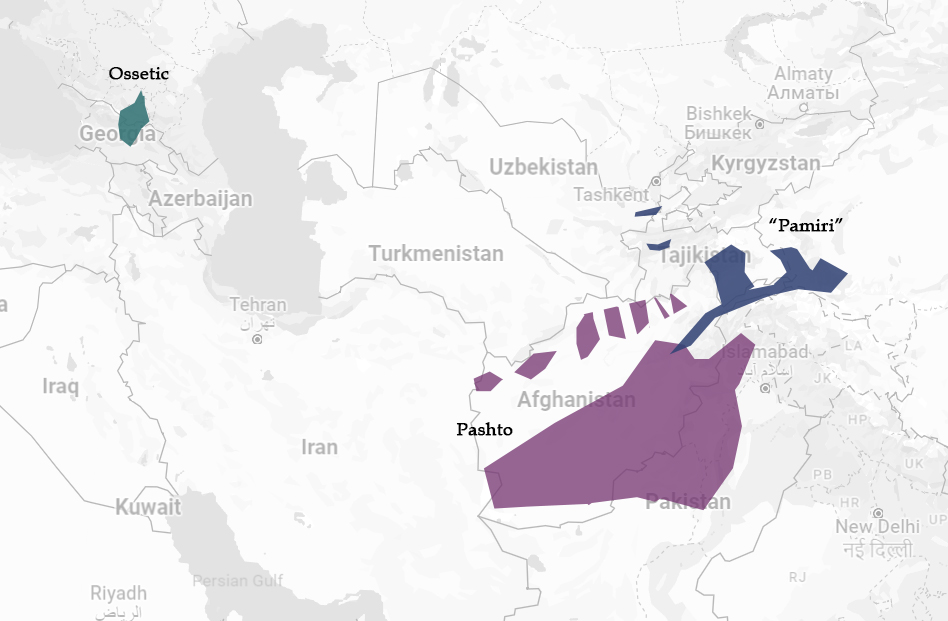
To quickly situate us, Ossetic is an Iranian language spoken in the mountains of the Caucasus. Maybe one of the more curious things about Ossetic is that it has properties that group it as an East Iranian language, and East Iranian languages are geographically really far away.
One of the characteristics of Ossetic that group it as East Iranian are its stress rules. At their basic, they are stated as follows:
There are two categories of vowels,
Weak: æ ы
Strong: a и y e o
In a (phonological) word, if the first syllable contains a strong vowel, it receives the stress; if the vowel of the first syllable is weak, stress falls on the second syllable.
Looking at a handful of Ossetic example words below, we see that this rule applies regularly and straightforwardly.
ахсæн
хурыскæсæн
арфæ
сидын
судзын
æхсаргард
хъæдабæ
дзындзалæг
æлутон
хæрæфырт
– >
ахсæн
хурыскæсæн
арфæ
сидын
судзын
æхсаргард
хъæдабæ
дзындзалæг
æлутон
хæрæфырт
This stress rule is one of the features that place Ossetic among East Iranian languages because it appears to inherit the Rhythmic Law – a rule for stress distribution in Sogdian proposed by Gerschevitch in 1948, which is very effective at explaining many Sogdian morphological alterations. The rhythmic law basically states that Sogdian had heavy syllables and light syllables, if a word root would have a heavy syllable, it would receive stress; if it didn’t, the end of the word would receive stress. This accounts for the historical loss of word-final syllables in Sogdian word-forms with heavy syllables in the root.
light masc. ram- “people”
nom. ram-í < *ram-áh
heavy masc. mēθ “day”
nom. mēθ < *máiθ-ah
Ronald Kim identifies Ossetic stress with the Sogdian Rhythmic Law: He shows a clean correspondence between Ossetic strong vowels and the phonemes that define Sogdian heavy syllables and he reconstructs Ossetic stress placement as being on the strong-vowel syllable or on the end of the word (homologous to Sogdian stress placement) and argues that the constraint limiting stress to the first two syllables in Ossetic is a subsequent one.
Some Ossetic song genres
Heroic
There are three genres of songs I will present here, one of them I won’t dwell on much, but it is prominent in Ossetic musicology. These are called chants in the ‘heroic’ genre, where the accomplishments of historical figures during major historical events are narrated with a strong sense of drama.
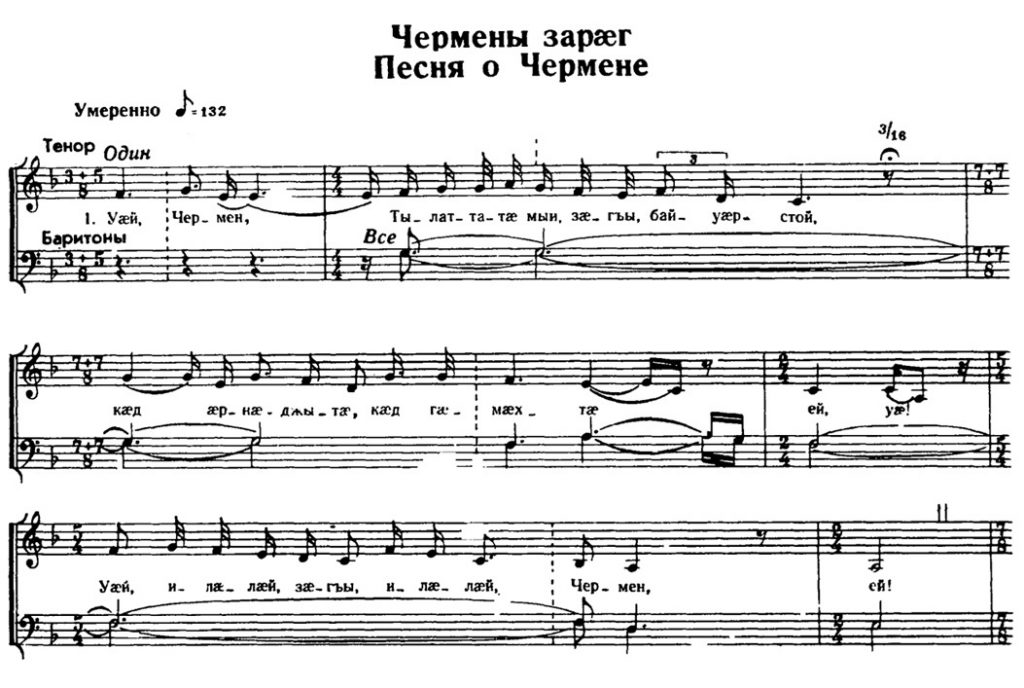
Above is a transcription of a version of this song (not exactly the one in the audio), and it’s missing an important feature that I want to use to constrain Ossetic stress patterns: it is missing a regular beat. For songs with regular beat structure, the meter will be stated at the beginning and most of the time never altered. Here however, every measure has a different meter, and the barlines are given as a suggestion (sometimes they’re dashed), which in the end means ‘there is no meter’. The melody here can have as many syllables as it wants, one more or one less will not harm the metrical structure, because there isn’t one. Galaev, an early ethnographer who collected these, described their texts as “not very distinguishable from prose” or “slightly rhythmisised prose”.
Estrada
A genre that does impose the constraint that I’m interested in is a more recent one, it is part of a genre that was called estrada in the USSR, it is pretty close to what is called pop in the West, except it was more regimented in the USSR – these songs are often made by lyricists and composers who were officially recognized as such after being trained in these specialties.
Хурзæрин
Below are the lyrics to the song Хурзæрин, glossed, translated, with stresses underlined.
Дардме дæр мæ уарзонæн
From.far then my love
Ис æнцонæй базонæн:
Is easily recognized
Худы мын йæ уадултыл
smiles at.me her cheeks.on
Хурзæрин.
sunshine
My love is then easily recognised from far away,
It smiles at me on her cheeks — sunshine
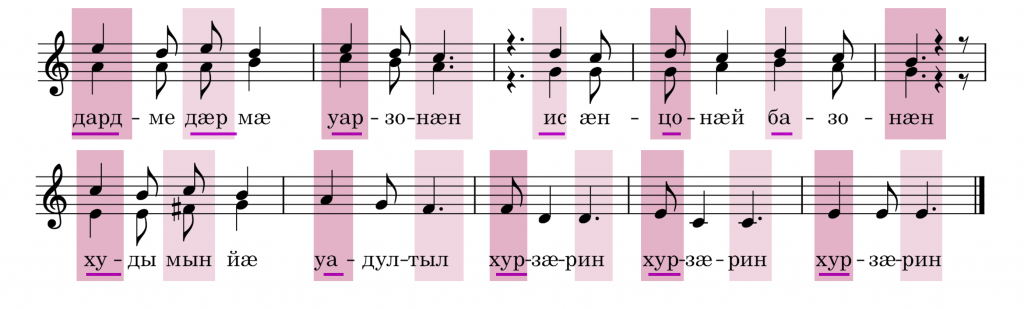
This same song, transcribed in musical notation above, has its strong beats as highlighted. You can see that all the stressed syllables of the text match with the strong beats of the music. This corresponds to the general expectation that the most prominent syllable of a word should match with the most prominent beat in a measure.
This is consistent with what we are used to in music in Western languages:
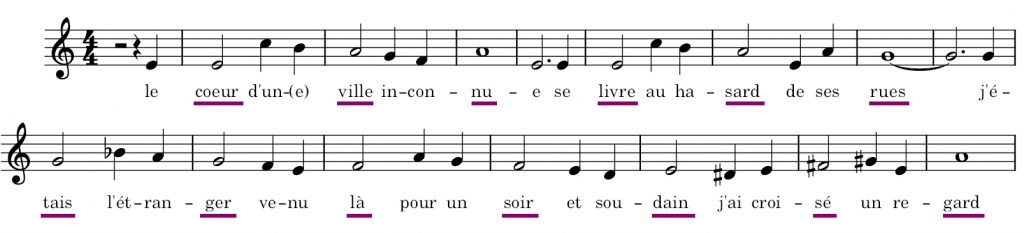
Examples of such correspondences can be multiplied, and I argue that there must be a rule that regulates our sense of these correspondences, because listeners can easily identify cases where that rule is broken, as in the chorus of a Katy Perry song below:

Ossetic estrada songs provide examples of another type of matching between musical patterns and stress patterns:
Мæ Ирыстон
Нæ хæхтæ, нæ фæзтæ,
Our mountains our fields
Нæ айнæг къæдзæхтæ
Our smooth cliffs
Уæ хæхтæ уæ царды
Your mountains your life
Сымах уыд мæ зæрды
you are my heart.in
Our mountains, our fields, our smooth cliffs
Your mountains, your life, you are in my heart
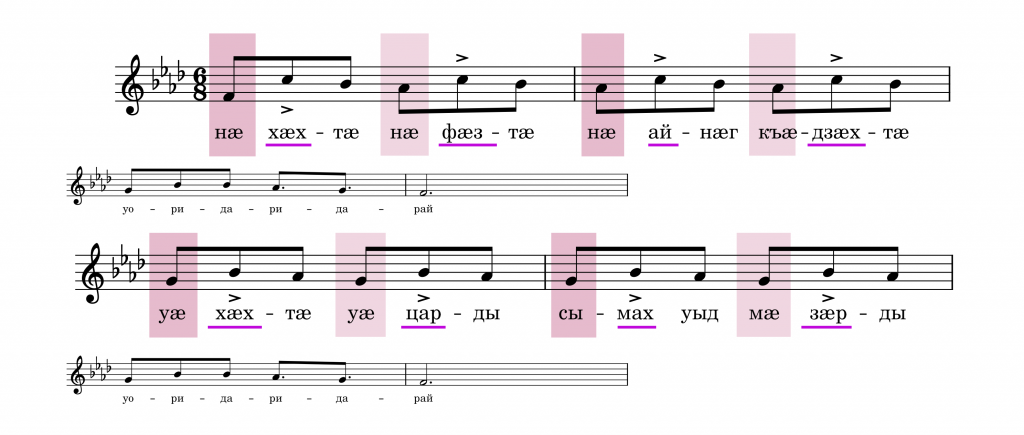
Here we can see that the stressed syllable doesn’t correspond to the strong beat of the meter, but that the melody has an accented note on every 2nd and 5th beat, and the stress matches that. This immediately complicates the picture for us because it means that the notion of ‘prominence’ in a melody doesn’t have to be tied to the regularly spaced meter, but can be tied to an accented note… and any note can be accented.
The nice clean matches end there, because much more often you get a mixed bag of matches and mismatches between stress patterns and melodic patterns in Ossetic songwriting.
Уалдзыгон райсом
Уалдзыгон райсом — сызгьæринбазыр,
Spring morning (is) golden wing
Амонды цинæй мæ риуы хъазы.
Of.happiness joy my chest.in plays
Зæрдæйы зарæг фестад уæларвон,
Heartfelt song became airborne
Чызджыты хуыздæр — мæнæн мæ уарзон.
Girls.among best (is) for.me my love
A Spring morning is a golden wing
Happy joy plays in my chest
A heartfelt song became airborne
My love for me is the best among girls
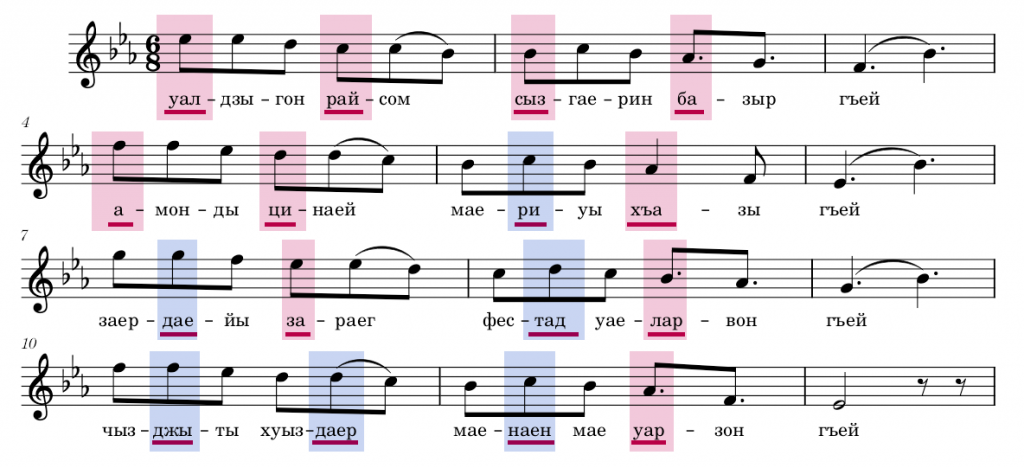
The melody transcribed here shows an equal distribution between stressed syllables falling on the first beat (highlighted red) and stressed syllables falling on the second beat (highlighted blue). The analysis that accommodates this data becomes too powerful, as it can account for the placement of a stressed syllable on any beat in any measure:
– A stressed syllable matches with a strong beat.
– When a stressed syllable doesn’t match with a strong beat, its corresponding note is accented.
If this previous melody doesn’t seem too compromising to the enterprise of matching beats to stressed syllables, you can find song examples with much more rampant mismatches

Art-song

To try to save the phenomenon, there are two available tools we can use. To present them, I will introduce Ossetic music of another genre, which is not as recent as the Soviet one, but not as remote as the heroic one. This genre can broadly be called ‘art song’, and is comparable to Western songs that have been set to works written by 19th century poets, such as the French mélodie genre, or the German lied. In the case of Ossetia, their national poet is Kosta Khetagkaty and his poetry and his biography is very much part of the European 19th century poetic tradition.
One piece he wrote is called Kubady. It has straightforward weak-strong stress patterns.
Хъуыбады
Сæрдæй, зымæгæй,
By.summer by.winter
Гуыбыр, тызмæгæй,
Hunchbacked, moody
Йæ кæрцы мидæг,
His wintercoat inside
Ныхасы1 бады
On.Nikhas he.sits
Зæронд Хъуыбады,
Old Khubady
Нæ фæндырдзæгъдæг…
Our lyre.player
By Summer, by winter,
Hunchbacked and moody,
He sits at the council
In his worn-out wintercoat
Old Kubady, our lyre-player
1Nikhas: People’s council
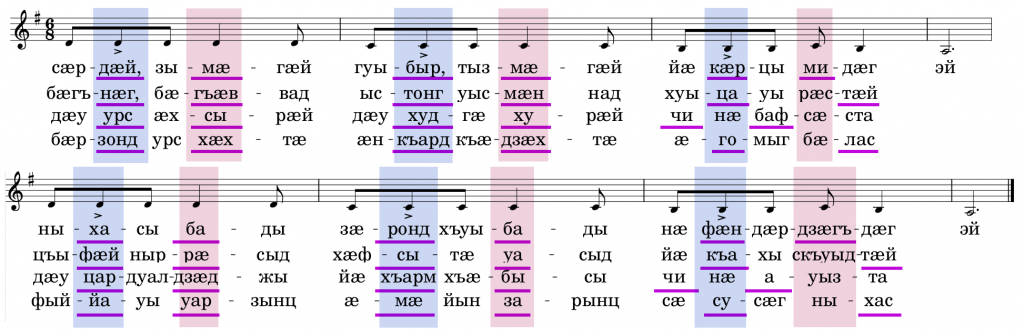
The way these verses were set to music, we can see that most of it is pretty systematic: stressed syllables occur on the 4th beat, which is a secondary strong beat in the 6/8 meter, while the strongest, 1st beat, is shifted away from by accentuating the 2nd beat, and this accentuation is very regular.
The first outliers can be seen in verses 3 and 8, where two pairs of line-final words have unexpected stress, рæстæй/скъуыдтæй and бæлас/ныхас. It is significant that these irregularities come in rhyming pairs, showing that they were intended by the poet.
Abaev’s accentual units
The tool we can use to bring them in line with the beat pattern of the song is Abaev’s description of phrasal stress in Ossetic, where he states that in larger phrasal groupings, stress is erased on all the words that form the group except the first one.
A group of words, being in a defined syntactic relationship, can carry one single stress (disregarding a set of secondary, very weak stresses). This forms an accentual unit. Such groups we will call word complexes, or just complexes. Stress in complexes is distributed following the same laws as in standalone, elementary words. (Abaev 1939)
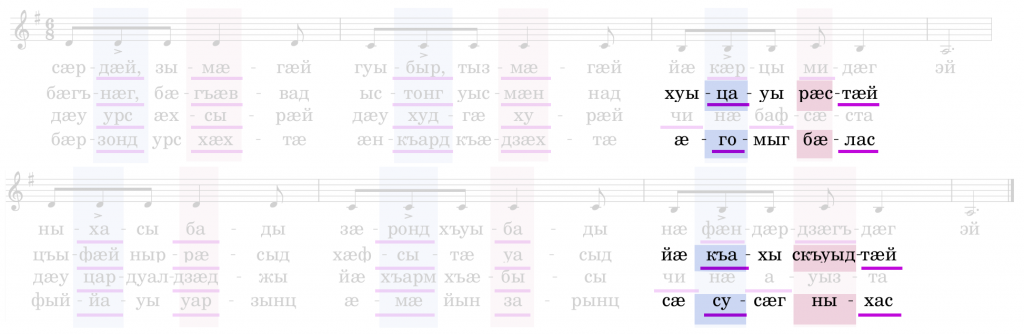
Following Abaev, we can more comfortably fit the mismatching stresses by simply erasing them, since the words to which they are tied participate in larger syntactic groups that begin earlier:
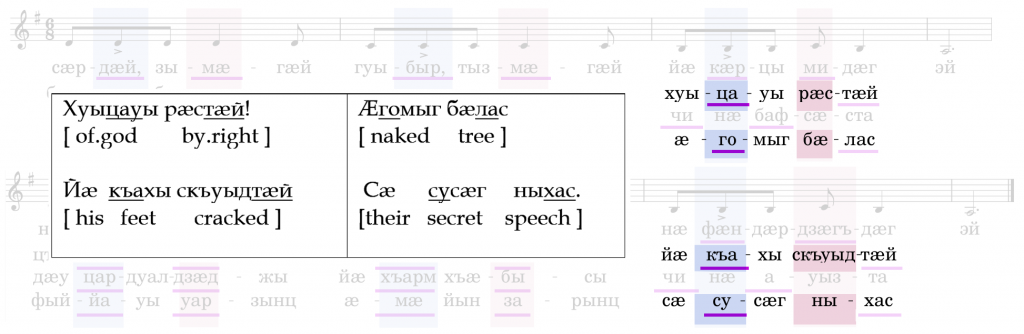
Above, the mismatching stress on рæстæй is erased, since it forms a single accentual group [хуыцауы рæстæй], where stress falls only on -ца-. The other three line endings group in a similar way and the problematic mismatch on the last stressed syllable is erased.
If we could settle this first set of mismatches, we are left with a more problematic one, which consists of two wh-sentences
… Дæу худгæ- хурæй / Чи нæ бафсæста
… you.acc smiling sun.with who neg. fed
Who didn’t feed you with a smiling sun
Дæу цардуалдзæджы / Йæ хъарм хъæбысы / Чи нæ ауызта
you.acc lifelover his warm hug who neg. caressed
Who didn’t caress you, lifelover, with his warm hug
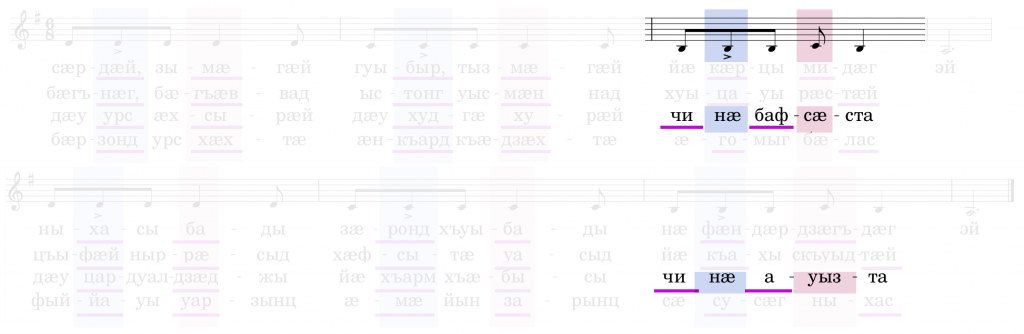
The stress placement in these two questions falls on чи and cannot fall on нæ, which clashes with the pattern established in the rest of the song. These wh-structures have meaning as exclamations and not interrogations, and Abaev can group very long exclamative strings as single accentual groups.
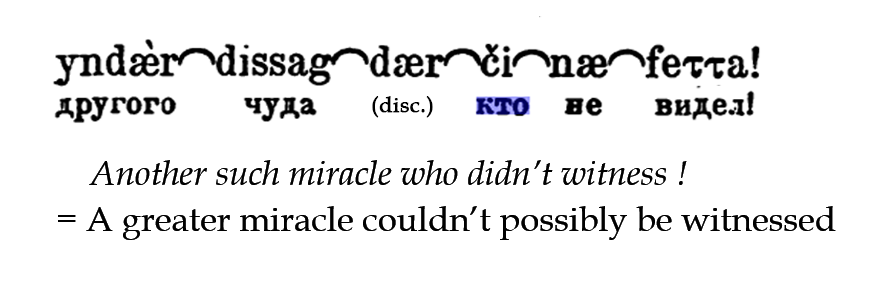
Above, the entire six-word string is grouped together and therefore only has one stress on the second syllable of the first word. The problem of a too-powerful analysis reappears here, since it often allows us to combine segments into increasingly bigger accentual groups to erase the stressed segments that don’t match the patterns we expect. In the Ossetic line above, we can solve the mismatches by grouping two lyric lines together (The surviving, non-erased stress has been capitalised):
Дæу цардуалдзæджы / [ Йæ ХЪАРМ хъæбысы / Чи нæ ауызта ]
you.acc lifelover his warm hug who neg. caressed
Who didn’t caress you, lifelover, with his warm hug
But if issues were present in the second line, nothing would constrain us from grouping the whole sentence together to keep only the non-problematic stress.
[ Дæу ЦАРДуалдзæджы / Йæ хъарм хъæбысы / Чи нæ ауызта ]
you.acc lifelover his warm hug who neg. caressed
Who didn’t caress you, lifelover, with his warm hug
More damning than the issue of too much explanatory power, is that native speakers, both when singing this poem and reciting it, accentuate the wh-word, which is evidence against an accentual group that stretches further left than чи.
In the audio segments above, we can see a clear emphasis of the чи wh-word. Abaev’s accentual grouping can’t account for its mismatch, but significantly, neither can the approach discussed earlier, whereby the melody note associated with the stressed syllable can simply be accentuated where needed. This can be demonstrated by native speakers’ grammaticality judgments when hearing prepared melodies.

In the prepared melody above, нæ is unstressed, but falls on the strong beat in a rising melody where the note carrying нæ is longer than the note introducing it. All these factors add more emphasis to the strong beat in the melody. It is difficult and unnatural to accent the beats carrying the stressed syllables чи, баф- and а- in disregard of the measure’s strong beat. Native speakers of Ossetic find no issue with such a melody, which is a surprising grammaticality judgment, considering how jarring and ungrammatical the mismatch in Kary Perry’s ‘Unconditionally’ can sound to native speakers of English.
Two-fold strength gradations
To address this issue, we can argue that the dominating aspect for determining stress here is the foot, which disregards word boundaries and syntactic boundaries. To this effect, we establish a binary-branching hierarchy of the beat structure to which these feet are set.
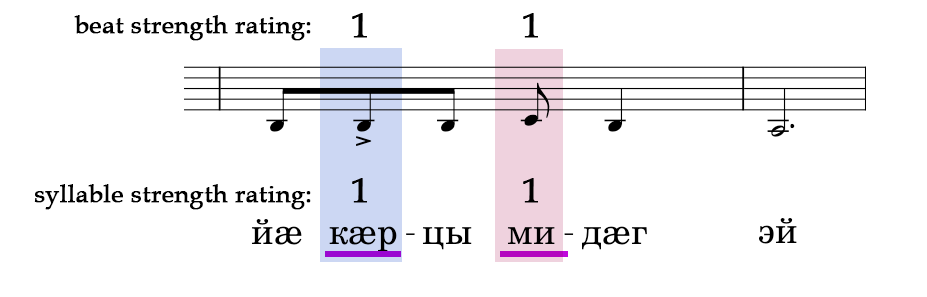
Since the lyrics of Kubady follow a regular weak-strong pattern, the strength of the syllable can either be rated 1 (strong) or 2 (weak).
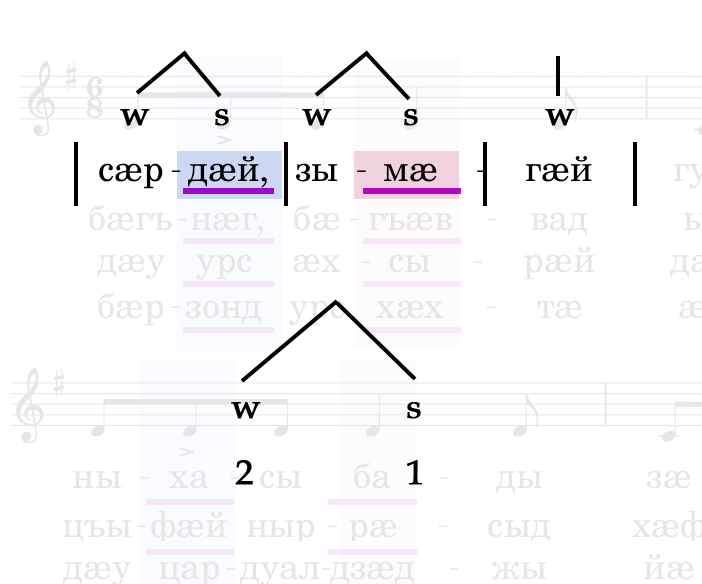
If we give a similar 1 (strong) and 2 (weak) rating to strong and weak beats in the melody, we see that in the lines of Kubady where syllabic stress and beat strength match, the beat rated 1 in the music corresponds to a syllable strength rated 1.
In lines where the syllabic stress does not match, the beat rated 1 corresponds to a syllable strength rated 2.
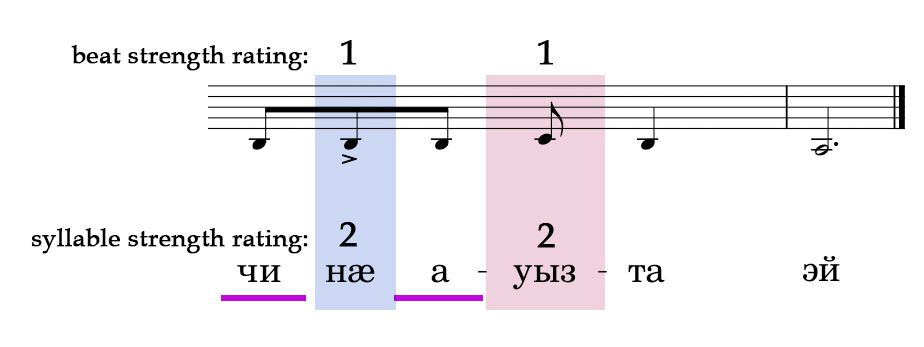
Ossetic seems to be tolerant of it, because, as demonstrated above, for experimental melodies that use all the musical means to emphasize the beat of the unstressed syllable, the result is not considered odd or weirdly phrased for native speakers.
Three-fold strength gradations
It is however possible to find beat hierarchies and syllable hierarchies that offer more than a two-way weak-strong division. Manipulating these hierarchies can reveal a breaking point in Ossetic text setting.
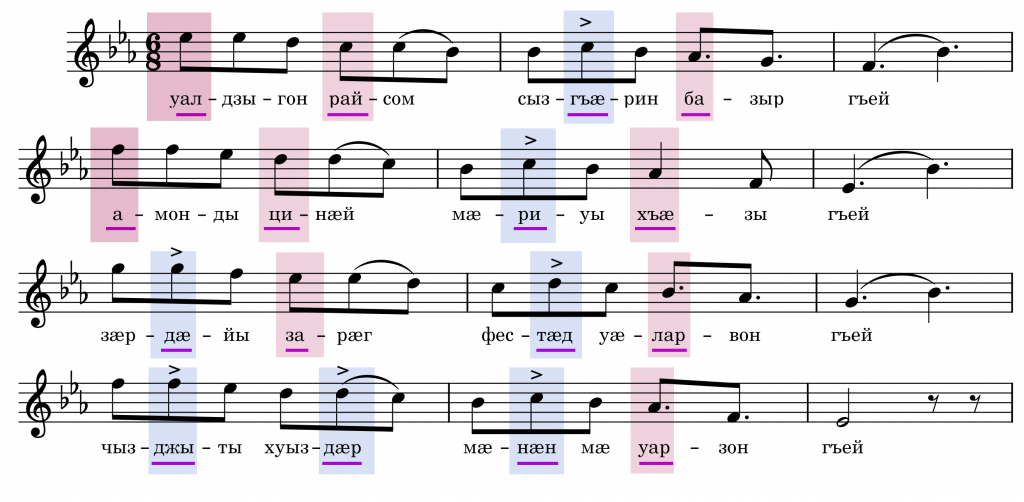
Returning to an estrada song that was discussed earlier, we see that its poetic meter isn’t the alternating strong-weak of Kubady, but that it has a few dactyls: strong-weak-weak. If we assume a binary-branching hierarchy, it will give us a greater gradient than just strong (1) and weak (2):
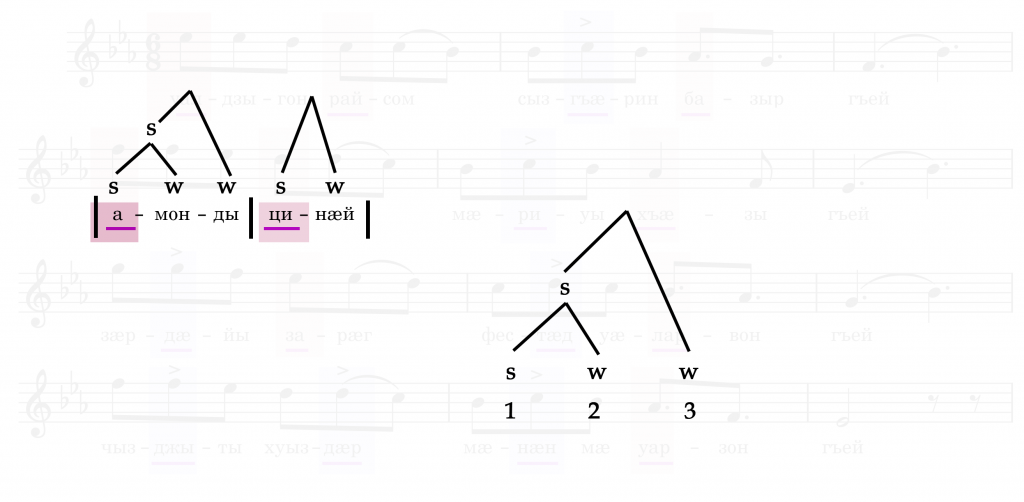
We now have a rating: strong (1), weaker (2) and weakest (3). For this new gradation, we predict that if a syllable rated 2 in the poetic foot falls on a strong beat, it will not cause an accentual dissonance, but if a syllable rated 3 falls on a strong beat – it will. An experimental melody composed to force a syllable rated 3 on a strong beat is perceived as ungrammatical by a native speaker.

I argue that the reason for this ungrammaticality is that the melody contains two syllables rated 3 which occur on a beat rated 1, as shown in the following breakdown. The trees above the melody line represent beat structure for every measure, the trees below the melody line represent syllable strength structure for the words уалдзыгон and амонды.
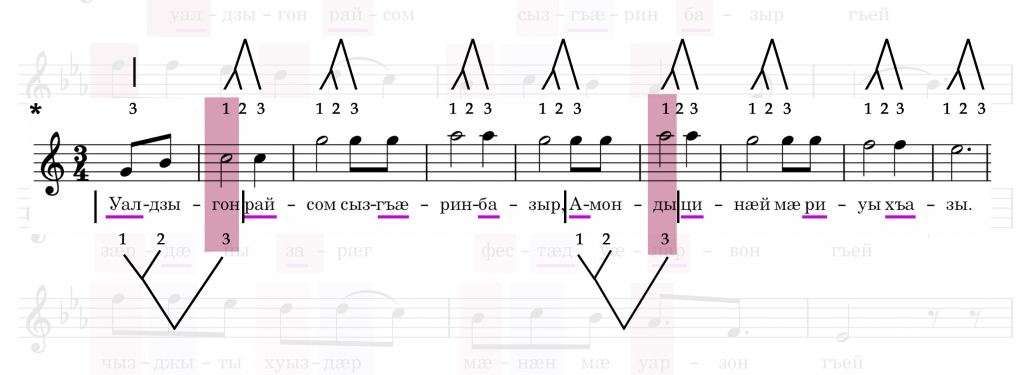
It must be added here that the rating system just given for the poetic meter should be applied as much to the musical meter, except further gradations for the strength of a musical beat should be available. In the experimental melody shown here, the notes are emphasized not only by the strong beat, but also by being melodic peaks and by being longer than their neighbours. These factors are absent from the passages of the Soviet song, shown again here, which is what makes segments like ‘фес-’ acceptable on the strong beat.

Insights into three-syllable word structure
Lastly, we set aside the previously given foot-based analysis of the Kubady song and turn our attention to some of its three-syllable words, such as зымæгæй (by winter). The stress falls on the middle syllable and we have no evidence to choose one branching over another if we want to propose a binary-branching structure of an Ossetic word’s stress pattern.
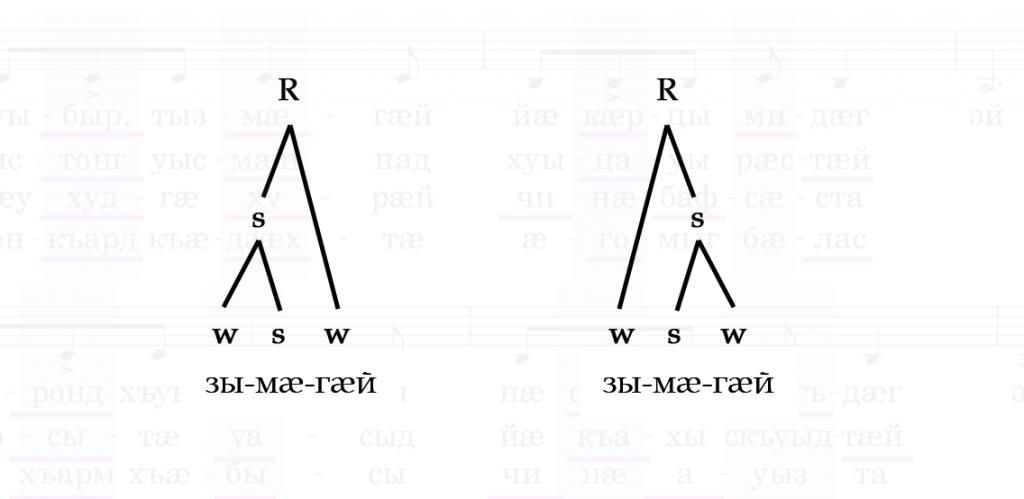
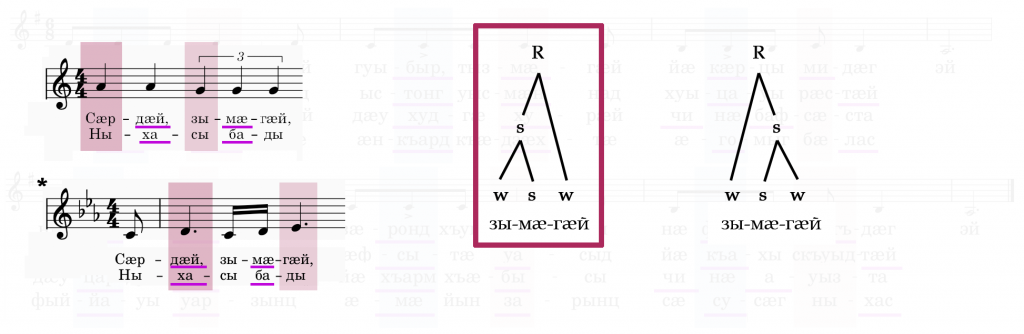
However, setting these lyrics to experimental melodies, we see that a melody which places a strong beat on the first syllable (зымæгæй) is not considered jarring by a native speaker:

On the other hand, a melody that places emphasis on he last syllable (зымæгæй) is considered jarring:

In this way, text setting can allow us to make a claim about the inner stress pattern of given Ossetic words, since syllables of grade 2 strength do not sound ungrammatical to native speakers when matched with grade 1 beat strength, whereas syllables of grade 3 strength do.
Conclusions
Understanding the properties of a language’s stress pattern can give insights into that language’s syntactic structure. For example, Borise & Eschler 2021 argue that there is a connection between prosodic phrasing and verb position in Ossetic.
The interaction of Ossetic stress patterns with music can therefore be a productive topic of investigation because music imposes its own beat structure on a language’s stress pattern and its own melodic contour on a language’s prosodic phrasing. Under these constraints, it is possible to see syntactic structures in contexts that are otherwise ambiguous.
In the example below, a musical rephrasing leads to a syntactic reanalysis of the sentence.
(2a) хъуынджын галтæ æрбатардта базармæ
Shaggy bulls he.drove to.bazaar
(2b) [хъуынджын галтæ] æрбатардта базармæ
He drove shaggy bulls to the bazaar
(2c) [хъуынджын] галтæ æрбатардта базармæ
“Shaggy” drove the bulls to the bazaar
By itself, the text in (2a) does not reveal its internal division into constituents, but text setting can make the interpretation unambiguous depending on how much space the melody leaves between shaggy and bulls:


Melody (3a) unambiguously reads shaggy bulls since галтæ ‘bulls’ appears on the next eighth note after хъуынджын ‘shaggy’ and doesn’t fall on a strong beat, which prevents it from forming its own prosodic group. Melody (3b) unambiguously reads “Shaggy” drove the bulls since there is a lot of space between галтæ ‘bulls’ and хъуынджын ‘shaggy’, and галтæ appears on a strong beat, which allows it to form a constituent separate from хъуынджын.
Bibliography
Abaev, I. Vasily. 1939. Iz Osetinskogo Eposa (From the Ossetic Epic). Moscow: Publishing House of the Academy of Sciences of the USSR
Borise, Lena & Erschler, David. 2021. Verb height indeed determines prosodic phrasing: evidence from Iron Ossetic. Proceedings of NELS 51, 65-74.
Galaev, A. Boris. 1964. Osetinskiye Narodnye Pesni (Ossetic Folk Songs). Moscow: Music
Gershevitch, Ilya. 1948. Iranian notes. TPS 1948: 61–68.
Hayes, Bruce. 1983. A Grid-Based Theory of English Meter. Linguistic Inquiry, Vol. 14 No.3, 357-393